Between Fragmentation and Intelligence: The Global Economy’s Next Regime

By Wei Yao, Global Chief Economist and Head of Research for Asia Pacific, Societe Generale
The article was first published on HongKongEcho.
1. Has the global economy entered a new equilibrium?
Not yet. The global economy has demonstrated considerable resilience, but resilience should not be confused with equilibrium. We remain in a transition between an old model built around globalisation, low inflation and cheap capital, and a new regime whose organising principles are still taking shape.
Two tectonic forces are driving that transition: geopolitics and artificial intelligence. Geopolitics is eroding the peace dividend, weaponising economic interdependence and forcing supply chains to prioritise security and redundancy over pure efficiency. AI is pulling in the opposite direction, promising greater productivity, scale and automation. Yet both are capital-intensive, increasing demand for factories, data centres, power grids, semiconductors, critical minerals and skilled labour.
The next phase is therefore likely to feature more investment-intensive growth. Defence, energy security, digital infrastructure and supply-chain resilience will claim more capital. AI may raise productivity, but the speed and distribution of that benefit remain uncertain. Governments must simultaneously rebuild fiscal space, manage ageing populations and maintain social support for economic change.
For companies, the practical implication is that efficiency alone is no longer an adequate strategy. Robustness matters more: diversified sourcing, secure energy, technological adaptability and stronger balance sheets. The new equilibrium will arrive only when institutional arrangements catch up with technological and geopolitical change. History suggests that this process is rarely smooth. Technology moves first, capital follows, and institutions adjust last.
2. Are we entering a new era for interest rates?
Businesses should prepare for interest rates to remain structurally higher and more volatile than during the decade before 2020. This does not mean policy rates will keep rising indefinitely. Rather, the floor beneath interest rates has probably shifted upwards, while their path around that level will be less predictable.
Three forces underpin this new regime. First, inflation risks have become more persistent. Geopolitical disruptions can quickly raise energy and supply-chain costs, while the AI investment boom is generating immediate demand for power, data centres, semiconductors and skilled labour. AI may eventually lower costs through higher productivity, but its near-term effect is more likely to add to capital and resource demand. Also, if AI could truly lift long-term potential growth, it would argue for higher real neutral interest rate.
Second, fiscal policy is putting upward pressure on long-term rates. Governments must finance ageing populations, defence, energy security, infrastructure and industrial policy, often from already elevated debt levels. Larger bond issuance, higher refinancing costs and reduced central-bank purchases require private investors to absorb more sovereign debt. The resulting fiscal-risk and supply premia can keep long-term yields high even when central banks eventually reduce short-term rates. Debt maturity also matters: governments relying more heavily on short-term borrowing will feel higher financing costs sooner.
Third, monetary-policy communication is changing at the Fed. Under Kevin Warsh, the Fed has stepped back from explicit forward guidance, arguing that it is ill-suited to the present uncertainty. Markets are increasingly being asked to react to incoming data rather than follow a clearly signalled policy path. Warsh himself acknowledged in July that reduced forward guidance may have contributed to the material rise in nominal and real Treasury yields.
For companies, the message is straightforward: do not build business models around a return to ultra-cheap money. Investment decisions should be stress-tested against higher real discount rates, volatile long-term yields, wider refinancing spreads and sharper currency movements. The defining feature of the new era may be not simply higher rates, but a higher cost of uncertainty.
Chart: Inflation has remained well above pre-2020 levels 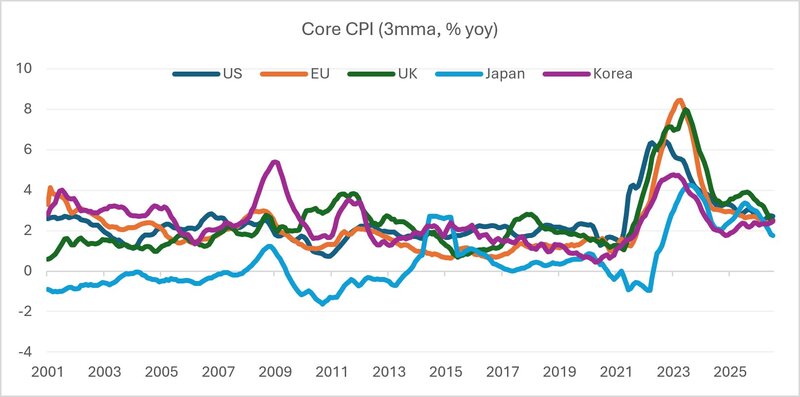
Source: SG Cross Asset Research/Economics, CEIC
3. What is most critical risk to watch today?
The most important risk is not a single geopolitical event or economic shock. It is the interaction between elevated real interest rates and a potential delay in the monetisation of AI.
AI holds enormous long-term promise, but the current build-out requires spending on chips, data centres, energy, cooling, grids, land and communications infrastructure. The technology may advance quickly, while corporate adoption, organisational reform and revenue generation move much more slowly. Companies must redesign processes, governance, skills and incentives before technical capability becomes economy-wide productivity.
That timing mismatch matters because financing structures are changing. AI-related investment increasingly requires a shift from internal cash flow towards debt and private credit. Hyperscalers’ underlying businesses remain highly profitable, but infrastructure spending is absorbing most of their operating cash flow. Some of them have moved into negative free cash flow, while debt and long-term contractual obligations are rising.
The risk is therefore not that AI fails. It is that the technology succeeds more slowly than financial markets and investment plans currently assume. If revenues disappoint while real financing costs remain high, valuations could correct, credit spreads could widen and planned capex could be cut. Because AI investment now supports economic growth, trade and market confidence, that correction could become macroeconomic rather than remaining confined to the technology sector, as rich equity valuations and corporate-credit exposure could amplify an AI-related repricing.
Two indicators deserve particular attention. The first is leverage, including debt, private-credit exposure, guarantees and circular financing within the AI ecosystem. The second is distribution. If productivity gains accrue mainly to capital while labour income and broad-based demand weaken, political and social resistance will rise. The narrow margin of error lies between AI not becoming productive quickly enough and becoming productive without generating sufficiently broad demand.
Chart: Corporate debt level still manageable 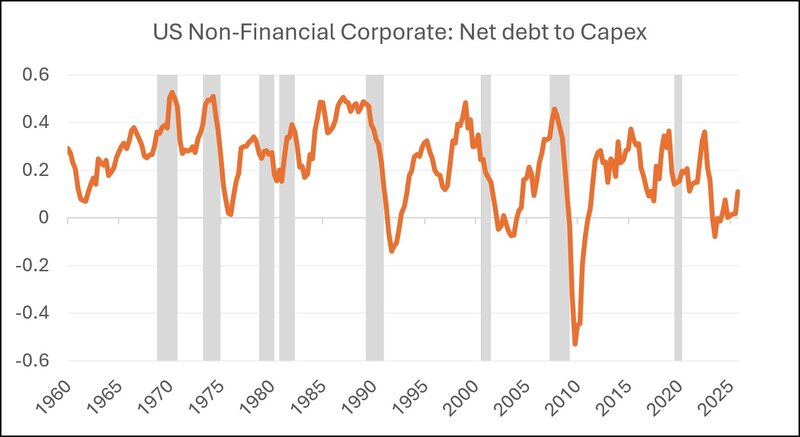
Source: SG Cross Asset Research/Economics, BLS
4. Why does Asia matter more than ever?
Asia matters because it sits at the intersection of the global economy’s most important growth engines: technology, manufacturing, urbanisation, supply-chain reorganisation and rising consumer demand. The region is not merely participating in the next economic regime. It is helping to build it.
Asia-Pacific was projected to contribute approximately 60% of global growth in 2025 and 2026. Its resilience has been supported by technology investment, AI-related exports, policy support and the reconfiguration of supply chains within the region. Korea, Japan and Taiwan are central to advanced technology production, while ASEAN and India offer expanding manufacturing, services and consumer markets.
The region nevertheless faces significant challenges. It remains deeply exposed to imported energy shocks. It is also at the centre of strategic competition over semiconductors, critical minerals and manufacturing capacity.
Chart: Asia dominates AI hardware exports 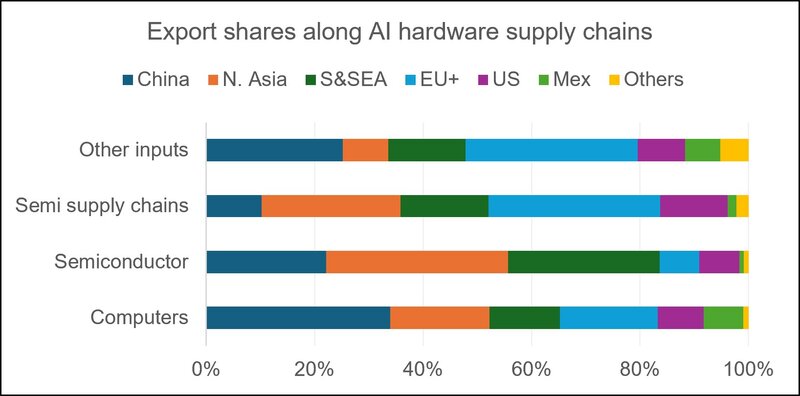
Source: SG Cross Asset Research/Economics, CEIC, UN Comtrade
5. What is the next chapter of China’s economic story? And what role can Hong Kong play?
China is moving from a period of rapid expansion towards a more difficult process of economic rebalancing. Its central challenge is not an absence of productive capacity. It is a widening gap between formidable supply capabilities and insufficient domestic demand.
The existing model remains powerful. China retains enormous industrial scale and critical positions in areas ranging from electrification and clean energy to rare earths, machinery and technology supply chains. Manufacturing investment and exports have helped offset the prolonged property-sector adjustment. China’s exports also remain important to the global technology and AI cycle.
However, this strength creates its own tensions. China’s property correction has weakened household wealth and local-government finances. Private demand remains subdued, while low inflation has contributed to real exchange-rate depreciation and stronger net exports. Meanwhile, ever expanding trade surplus is increasingly difficult given China’s size and intensifying trade tensions.
The next chapter must therefore be about consumption and productivity rather than another round of debt-financed investment. Stronger social protection, better healthcare and pension provision, and greater support for migrant and lower-income households would reduce precautionary saving. Property restructuring and reform of local-government finances would help restore confidence. A more level playing field between private, state-owned and foreign firms would improve capital allocation and encourage innovation.
The opportunities remain substantial. An economy of China’s scale does not need exceptionally rapid growth to generate large markets. AI adoption, services, healthcare, green technology and advanced manufacturing can all expand. But the transition will be gradual and challenging.
Hong Kong’s role in this landscape is distinctive. Its value lies in translating between systems: Mainland China and international markets, renminbi and global currencies, bank finance and capital markets, and Chinese companies and foreign investors. This function becomes more important, not less, as the global economy fragments.
The expansion of the HKMA’s RMB Business Facility, the continued development of Bond Connect, Swap Connect and offshore RMB instruments, strengthens Hong Kong’s ability to support trade, investment and corporate treasury operations across Asia, Europe and the Middle East.
For European businesses, Hong Kong can remain a base for regional financing, RMB risk management, professional services and engagement with Chinese companies expanding overseas. Its comparative advantage is no longer simply being a gateway to China. It is being a connector across an increasingly complex Asian economic network.
Chart: China’s economic growth is now heavily reliant on external demand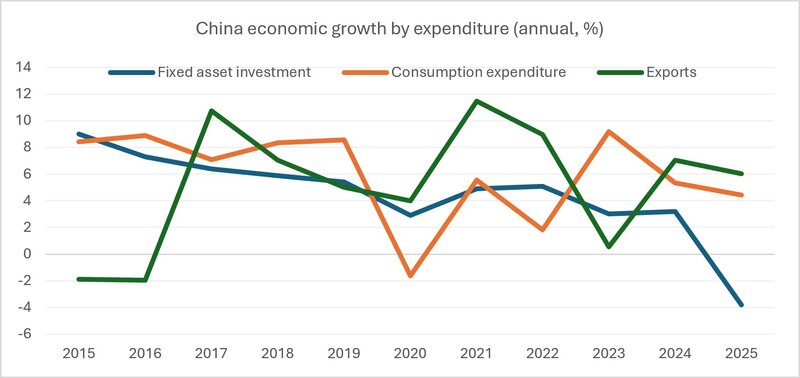
Source: SG Cross Asset Research/Economics, NBS

ソシエテ・ジェネラル、伊藤 潤を日本における投資銀行本部 資本市場部長に任命
ソシエテ・ジェネラルは、伊藤 潤(Jun Ito)を日本における投資銀行本部 資本市場部長に任命したことをお知らせします。

ソシエテ・ジェネラル、マーク・サフォンを日本におけるグループ・カントリー・ヘッドに任命
ソシエテ・ジェネラルは本日、2026年9月1日付でマーク・サフォン(Marc Saffon)を日本におけるグループ・カントリー・ヘッドに任命することを発表しました。

By Wei Yao, Global Chief Economist and Head of Research for Asia Pacific, Societe Generale

Societe Generale helps corporates navigate a rapidly changing payments ecosystem by bringing together traditional...

By Puneet Singh, Head of Cross Asset Quant, Asia Pacific

By Mark Chng, Head of Fixed Income & Currencies Sales, Southeast Asia

By David Jiang, Head of Industry Group, Industrial and Technology, Asia Pacific.